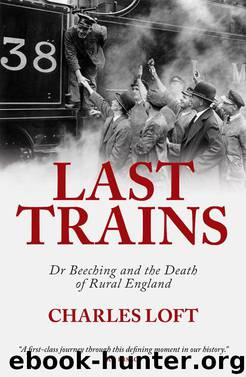
Last Trains by Charles Loft
Author:Charles Loft [Charles Loft]
Language: eng
Format: epub
ISBN: 9781849545631
Publisher: Biteback Publishing
Published: 2013-03-13T16:00:00+00:00
If there was a chance of the plan succeeding, it rested on the Association being able to get the new service up and running quickly, before commuters made alternative arrangements – but this proved impossible. The BTC and the ministry entered into discussions with the WVRA, but the prospect of ‘serious services [operated by] bands of enthusiastic amateurs’ were the stuff of officials’ nightmares; not because they were afraid the amateurs might succeed, but because they feared being left with the consequences of failure: an unmaintained railway; an unprovided service; and – disaster – no statutory procedure for dealing with it.181 The Association was almost certainly being unduly optimistic in anticipating a small profit and was certainly optimistic in hoping to pay a sliding-scale rent linked to the number of passengers transferring to the national network at Dunton Green. It also had a habit of rounding up commuter numbers to 200 and hoped to more than double its membership while increasing fees from 2s 6d to a pound. A copy of the proposal in the region’s files has a number of scribbled criticisms and queries, including over the estimate of maintenance costs and discrepancies between wage levels and union rates. The Commission decided in April 1962 that in future it would only transfer lines to preservation societies through outright sale, possibly in response to events in Westerham. The Association continued to lobby for a lease and began looking for the £60–70,000 it would need to buy the railway. In the meantime it leased Westerham and Brasted stations, restoring them and connecting them by telephone for the first time; occasionally a car mounted on a railway truck was driven along the abandoned track. Meanwhile officials had drawn up a set of questions to establish both the safety and the financial stability of the WVRA’s proposed operation. Its answers were only partially satisfactory and, before the remaining queries could be dealt with, the Association abandoned its plan to run a commuter service, precipitating the collapse of the whole effort under a wave of tarmac.
Marples was fascinated by the prospect of rebuilding urban Britain to accommodate the motor car and was heavily influenced by Professor Colin Buchanan’s 1958 book Mixed Blessing: The Motor in Britain. He appointed Buchanan to produce a report, Traffic in Towns, published in November 1963, which put forward expensive proposals for reconstructing cities to cope with traffic. That such an approach appealed to Marples the construction magnate is unsurprising, but if he saw profits for his kind in such an approach, he was also genuinely inspired – like so many others – by dreams of a new, concrete Britain. In 1962, as Macmillan tried to develop his ideas on modernising Britain into a theme for the next election, Marples proposed retraining tens of thousands of redundant railwaymen and shipbuilders for two massive construction projects: government acquisition of urban areas (between 100 and 200 acres) for redevelopment and ‘the high-quality design and production of living units, such as kitchens and bathrooms’.
Download
This site does not store any files on its server. We only index and link to content provided by other sites. Please contact the content providers to delete copyright contents if any and email us, we'll remove relevant links or contents immediately.
Whiskies Galore by Ian Buxton(41996)
Introduction to Aircraft Design (Cambridge Aerospace Series) by John P. Fielding(33122)
Small Unmanned Fixed-wing Aircraft Design by Andrew J. Keane Andras Sobester James P. Scanlan & András Sóbester & James P. Scanlan(32796)
Aircraft Design of WWII: A Sketchbook by Lockheed Aircraft Corporation(32288)
Craft Beer for the Homebrewer by Michael Agnew(18237)
Turbulence by E. J. Noyes(8040)
The Complete Stick Figure Physics Tutorials by Allen Sarah(7366)
The Institute by Stephen King(7028)
The Thirst by Nesbo Jo(6934)
Kaplan MCAT General Chemistry Review by Kaplan(6930)
Bad Blood by John Carreyrou(6613)
Modelling of Convective Heat and Mass Transfer in Rotating Flows by Igor V. Shevchuk(6434)
Learning SQL by Alan Beaulieu(6282)
Weapons of Math Destruction by Cathy O'Neil(6267)
Man-made Catastrophes and Risk Information Concealment by Dmitry Chernov & Didier Sornette(6010)
Permanent Record by Edward Snowden(5840)
Digital Minimalism by Cal Newport;(5750)
Life 3.0: Being Human in the Age of Artificial Intelligence by Tegmark Max(5551)
iGen by Jean M. Twenge(5409)
